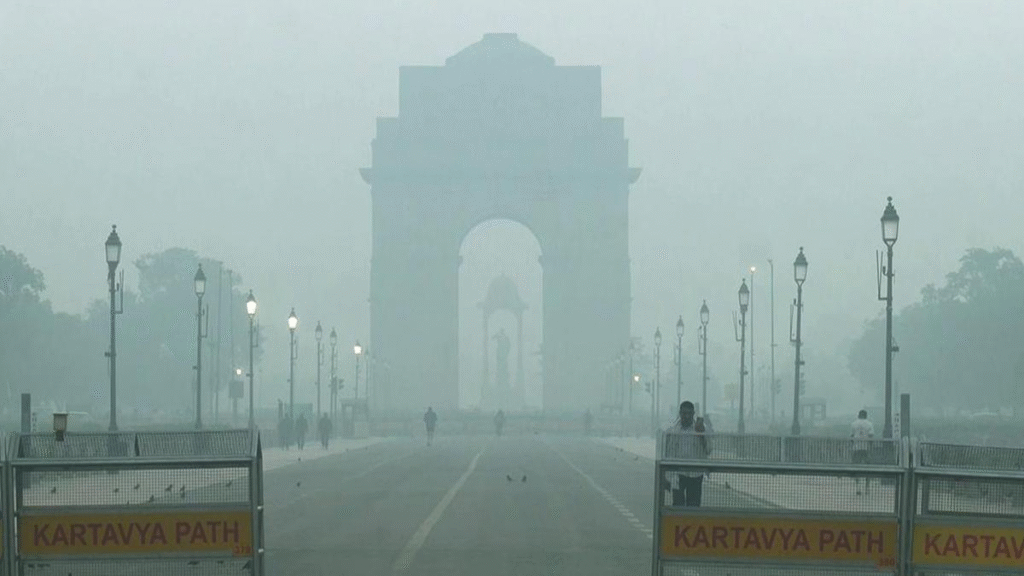
Delhi’s air quality worsens to ‘red zone’ with AQI at 335 and PM2.5 as the main pollutant, while temperatures drop to 11°C — signaling winter’s arrival amid toxic air.
🌁 Delhi’s Air Turns Hazardous: AQI at 335 in ‘Red Zone’
The national capital woke up to another morning under a thick blanket of smog 😷. On November 8, 2025, Delhi recorded an average Air Quality Index (AQI) of 335 at 9 a.m., putting the city firmly in the ‘red zone’ — a category that indicates ‘very poor’ air quality.
According to data from the Central Pollution Control Board (CPCB), Delhi has once again topped the list of the most polluted cities in India, with PM2.5 — fine particulate matter that can penetrate deep into the lungs — emerging as the primary pollutant.
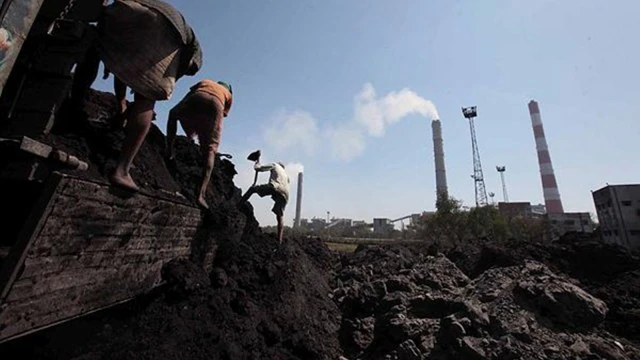
This spike comes just days after Deepavali (Diwali) celebrations, a time when pollution levels in northern India typically surge due to a combination of firecracker emissions, vehicular pollution, and stubble burning.
💨 What’s Driving Delhi’s Toxic Air?
Experts say that Delhi’s annual pollution crisis is a result of multiple compounding factors — not just local emissions. The city sits in a landlocked geography, with low wind speeds and temperature inversions during winter trapping pollutants closer to the ground.
Environmental scientist Dr. R.K. Sinha notes,
“After Deepavali, a cocktail of smoke from firecrackers, farm fires in Punjab and Haryana, and local traffic emissions combine under stagnant air, creating a toxic smog blanket.”
Satellite data also suggests that stubble burning across the northern plains peaked in early November, contributing up to 30–40% of Delhi’s total pollution load.
🌡️ Mercury Dips to 11°C — Winter Creeps In
While Delhi’s air quality continues to deteriorate, the city’s temperatures have begun their seasonal dip 🌬️. The India Meteorological Department (IMD) reported a minimum temperature of 11°C, about three degrees below normal, and a maximum temperature of 28.6°C, slightly lower than average.
In comparison:
- 2024: 9.5°C (Oct 29)
- 2023: 9.2°C (Oct 23)
- 2022: 7.3°C (Oct 29)
This data suggests that winter’s onset is slightly delayed this year — a trend consistent with climate variability seen across the region. The IMD has forecast clear skies for the coming days, meaning there will be little wind movement to disperse the pollutants trapped over the city.
🔬 Understanding the AQI Scale: What Does 335 Mean?
The Air Quality Index (AQI) is a measure of air pollution based on concentrations of various pollutants such as PM2.5, PM10, NO₂, and O₃.
Here’s how the scale breaks down:
| AQI Range | Category | Health Impact |
|---|---|---|
| 0–50 | Good ✅ | Minimal impact |
| 51–100 | Satisfactory 🙂 | Minor discomfort |
| 101–200 | Moderate 😐 | May cause breathing issues for sensitive people |
| 201–300 | Poor 😷 | Breathing discomfort to most people |
| 301–400 | Very Poor 🚨 | Respiratory illness, fatigue, eye irritation |
| 401–500 | Severe ☠️ | Health emergency; serious risk for all |
At 335, Delhi’s air is classified as ‘Very Poor’, bordering on ‘Severe’ — a level at which even healthy individuals can experience breathing difficulty, throat irritation, and eye discomfort.
🚗 What Authorities Are Doing (and What’s Missing)
In response to persistent smog, the Delhi government has reactivated its Graded Response Action Plan (GRAP), which includes:
- Restricting construction activities that generate dust
- Banning diesel generators (except for essential services)
- Increasing mechanical street sweeping and water sprinkling
- Encouraging public transport use through fare subsidies and extended metro timings
However, environmental activists argue that these are short-term measures that fail to address the root causes — such as unchecked vehicular emissions, industrial smoke, and seasonal crop residue burning.
“We need coordinated action among states, not just emergency firefighting,” says Sunita Narain, Director of the Centre for Science and Environment (CSE). “Without regional accountability, Delhi will continue to suffer every winter.”
🏙️ Citizens Struggle Amid the Smog
Residents across the city are feeling the impact firsthand. Schools have issued advisories for indoor activities, and many offices are reporting a rise in respiratory complaints.
Air purifiers are once again in high demand, and masks — a symbol of pandemic times — are back on Delhi’s streets.
“Even short morning walks feel like inhaling smoke,” says Neha Sharma, a resident of South Delhi.
Health experts advise citizens to:
- Avoid outdoor exercise in the morning and evening
- Use N95 or higher-grade masks
- Keep indoor air clean with purifiers or indoor plants
- Stay hydrated and maintain good ventilation indoors
🌍 The Bigger Picture: Climate, Policy, and Accountability
Delhi’s recurring smog crisis highlights a larger environmental and policy challenge — one that demands interstate coordination, stricter enforcement, and cleaner technology adoption.
Despite several court interventions and policy frameworks, implementation remains weak, and air quality improvements are often short-lived.
Experts also link the worsening AQI trends to climate change — as warmer autumns and delayed winter patterns reduce atmospheric dispersion, locking pollutants longer over urban areas.
Unless sustainable mobility, renewable energy, and agricultural reforms are prioritized, the capital may continue to experience this toxic déjà vu each winter.
☀️ What Lies Ahead
The IMD’s forecast of clear skies and low wind suggests little relief in the coming days. With winter setting in, pollution levels are likely to remain high until mid-December, when stronger northwesterly winds typically begin to clear the air.
Authorities are urging citizens to report illegal burning and reduce private vehicle use, but without systemic change, these appeals may not be enough.
For now, Delhiites brace themselves for another season of smog, where every breath feels heavier than it should 💔.
🪶 SEO Summary:
Delhi’s AQI hit 335, placing the city in the ‘red zone’. With PM2.5 pollution rising post-Diwali, temperatures dropping to 11°C, and winds stagnant, experts warn of a prolonged smog spell.