Thailand and Cambodia announce an immediate ceasefire after five days of deadly border clashes, following mediation by Malaysia and pressure from US President Donald Trump.
🕊️ Ceasefire Declared Between Thailand and Cambodia After Deadly Border Clashes
Thailand and Cambodia have reached an “immediate and unconditional” ceasefire, effective from midnight (Malaysia time), following five days of intense fighting along their disputed border that has killed at least 33 people and displaced tens of thousands.
The breakthrough was announced after emergency peace talks in Putrajaya, Malaysia, hosted by Malaysian Prime Minister Anwar Ibrahim in his role as ASEAN chair. The resolution follows pressure from U.S. President Donald Trump, who threatened to halt trade negotiations with both countries if they continued fighting.
🕯️ “It is now time to start rebuilding trust and confidence,” said Cambodian Prime Minister Hun Manet.
🕊️ “We are committed to peace and negotiated in good faith,” said acting Thai Prime Minister Phumtham Wechayachai.
💣 Five Days of Escalation: What Sparked the Conflict?
The clashes began earlier last week in a long-disputed border region, where historic tensions over demarcation lines reignited. Shelling, rocket attacks, and gunfire were reported from both sides, particularly near Preah Vihear temple, a UNESCO World Heritage Site claimed by both nations.
👥 Casualties and Damage:
- 33+ reported dead, most of them civilians
- Thousands displaced
- Damage to homes, schools, and religious structures on both sides
Though a ceasefire is now in place, Southeast Asia correspondent Jonathan Head cautioned that “it will be difficult to stop the fighting without a verified withdrawal of troops, which could take days.”
🗣️ Trump’s Threat That Forced Peace
US President Donald Trump played an unexpected role in the resolution by linking peace to trade. On Saturday, he posted on Truth Social:
🧨 “Trade talks are a no-go until such time as the fighting STOPS.”
By Sunday, Trump claimed he had personally called both leaders:
📞 “I called the prime ministers of each and said, ‘We’re not going to make a trade deal unless you settle a war’. A lot of people killed. I think by the time I got off, they wanted to settle.”
Though Malaysia received formal credit for the mediation, Trump’s economic leverage is seen as the turning point in pushing both parties to the table.
🤝 Ceasefire Terms and Next Steps
Here’s what was agreed during the Malaysia-hosted ASEAN peace summit:
✅ Ceasefire Provisions:
- Immediate and unconditional ceasefire effective from midnight Malaysia time (16:00 GMT)
- Military commanders from both countries to hold an informal meeting at 07:00 Tuesday
- ASEAN defense attaché meeting scheduled for August 4
- Resumption of direct communication between PMs, foreign ministers, and defense ministers
⚖️ Monitoring & Verification:
- ASEAN, led by Malaysia, will help set up a monitoring mechanism
- A framework for implementation, verification, and reporting is to be designed by ministers from the three countries
🌏 China and US Observers Present at Talks
Both China and the United States sent observers to the peace negotiations, highlighting the geopolitical importance of the conflict in a region where Beijing and Washington vie for influence.
- 🇨🇳 China has strategic and military ties with both Cambodia and Thailand
- 🇺🇸 The US is a major trade partner and defense collaborator in the region
The presence of both powers underscores the delicate diplomatic balance ASEAN nations are attempting to maintain amid escalating global rivalries.
📸 A Symbolic Ending: Unity Amidst Tension
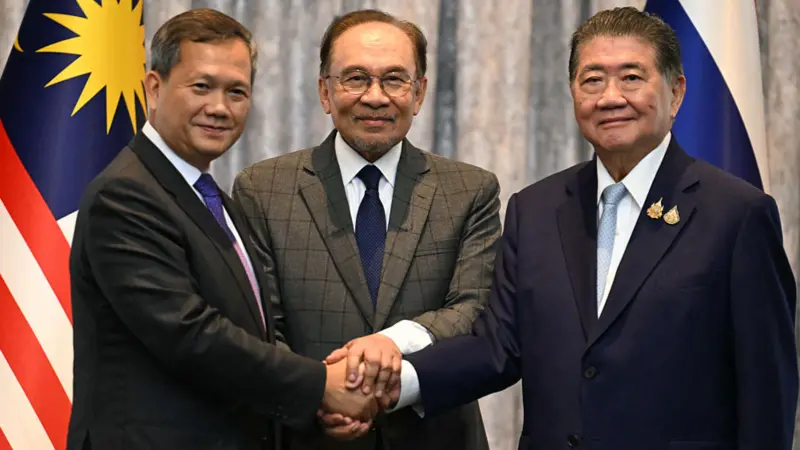
In true ASEAN tradition, the press conference concluded with the leaders of Cambodia, Thailand, and Malaysia holding hands for the cameras — a symbolic show of unity. However, they took no questions and were quickly escorted from the room.
Despite this public gesture, tensions remain. Shelling reportedly continued during the talks, and both governments face domestic pressure to appear strong.
🧠 Analysis: Peace—For Now, But Fragile
While the ceasefire is a welcome development, analysts warn that the underlying tensions are far from resolved:
- 🇰🇭 Cambodia’s forces were outgunned and had been urging for peace since Friday
- 🇹🇭 Thailand’s government was reluctant to accept third-party mediation until Trump’s threat
- 🛑 Border demarcation issues remain unsettled, with nationalists on both sides urging retaliation
Still, the rapid diplomatic response, especially through ASEAN’s mechanisms, shows the bloc’s renewed relevance in preventing conflict escalation in the region.
📝 Final Word
With diplomacy now prevailing over destruction, Southeast Asia breathes a sigh of relief. But without sustained dialogue and border agreements, the risk of renewed conflict remains high.
💬 “This is just the beginning of a long road to lasting peace,” one ASEAN diplomat noted off-camera.
📌 Stay with us for updates on troop withdrawals, verification mechanisms, and regional response.
👉 Subscribe for our Southeast Asia Conflict Tracker newsletter.
Suggested Featured Image:
A photo of the Cambodian, Thai, and Malaysian leaders holding hands post-ceasefire announcement, with flags in the background.