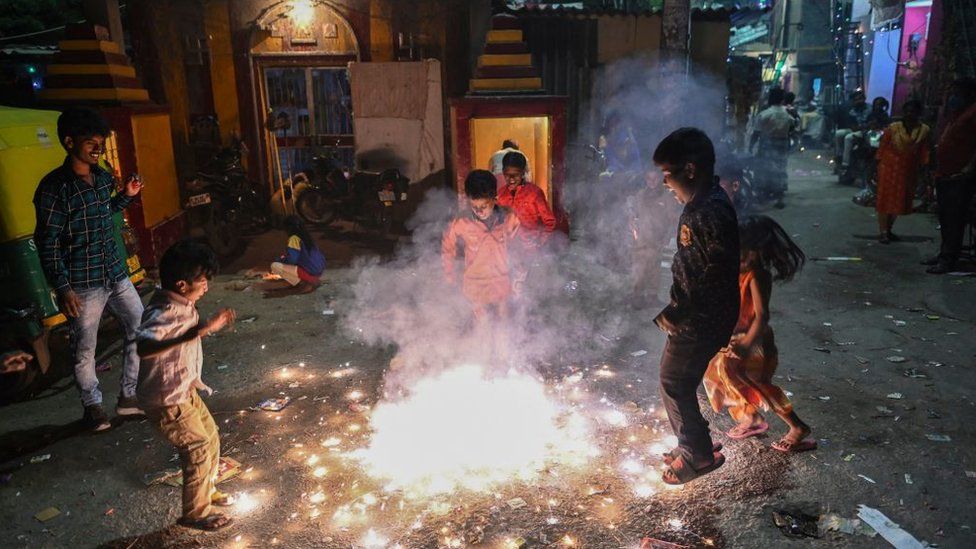
The skies over Delhi plunged into a thick, toxic hazard on Friday morning as a dense shroud of smog settled across the national capital region, the direct consequence of widespread, illegal firework combustion by revellers celebrating the Diwali festival. Despite a comprehensive, year-round judicial ban on the sale, storage, and detonation of traditional firecrackers imposed by local authorities to curb the perennial winter pollution crisis, residents openly flouted the restrictions late into the evening. The resulting surge in particulate matter instantly pushed the city’s air quality index into the severe category, triggering immediate health advisories from medical professionals who warned millions of citizens to remain indoors as visibility plummeted to hazardous levels across major thoroughfares and residential neighborhoods.
This alarming environmental regression is part of a deeply entrenched seasonal cycle that has plagued the world’s most populous democracy for nearly a decade. Historically, Delhi’s air quality begins a precipitous decline every October and November, driven by a lethal confluence of falling temperatures, stagnant wind speeds, regional crop stubble burning in neighboring agrarian states like Punjab and Haryana, and dense vehicular emissions. While authorities have attempted various mitigation strategies over the years—ranging from odd-even vehicle rationing schemes and construction bans to artificial rain trials—the Diwali festival period consistently acts as a severe tipping point, dramatically worsening an already fragile ecological baseline that local governments have struggled to permanently stabilize.
The sheer scale of the environmental degradation was immediately reflected in real-time monitoring data, which recorded concentrations of PM2.5—microscopic, cancer-causing particles capable of penetrating deep into human lungs—surpassing safe international limits by over twenty times in several vulnerable districts. Enforcement mechanisms proved largely ineffective as local police departments struggled to monitor thousands of residential colonies where firecrackers were openly ignited well past midnight. Environmental lawyers and public health advocates noted that the failure to curb the illicit trade of fireworks points to systemic enforcement gaps, despite the judiciary's repeated warnings that unmitigated pollution constitutes a direct violation of citizens' fundamental right to a clean and healthy life under the constitution.
Public officials and medical experts expressed profound dismay at the disregard for regulatory protocols, even as municipal workers scrambled to deploy mechanical sweepers and water sprinklers across arterial roads. "The blatant defiance of judicial directives not only sabotages our collective battle for clean air but places an immediate, catastrophic burden on our healthcare infrastructure," stated Dr. Arvind Kumar, a leading chest surgeon and founder of the Lung Care Foundation, who reported an immediate spike in emergency room visits for acute asthma attacks, bronchitis, and severe cardiovascular distress. Representatives from the Delhi Pollution Control Committee echoed these concerns, emphasizing that punitive measures against suppliers of illegal pyrotechnics would be drastically intensified in the coming days through coordinated nocturnal raids.
As the smoke slowly begins to clear, the broader economic and social ramifications of this environmental failure are reverberating across northern India, threatening productivity and placing immense strain on pediatric and geriatric medical wards. Market analysts note that chronic severe pollution episodes continue to deter foreign investment and tourism, while imposing billions of rupees in healthcare costs and lost labor output annually. Looking ahead, legal experts anticipate urgent petitions to be filed in the Supreme Court demanding stricter accountability from state machinery, while government agencies face mounting pressure to devise a radically more effective enforcement framework before winter weather patterns lock the toxic inversion layer firmly in place for the remainder of the season.
Source: Reuters • Read Original Reporting